
Reducing policy lookup time from several minutes to seconds for police officers
Shipped · UX Design · UX Research · Web · Mobile · iOS
How it all started: A broad AI brief
Axon asked a small cross‑functional team to explore how AI could augment law‑enforcement workflows, starting with incident analytics and reporting for chiefs and command staff. As discovery unfolded across chiefs, command staff, admins, and patrol officers, the work expanded from “help me make better reports” to “help me make better decisions in the field."
My Role
Lead/Solo Designer
Team
VP of product, 1 PM, 3 Backend Engineers, 1 Frontend Engineer, QA
Timeline
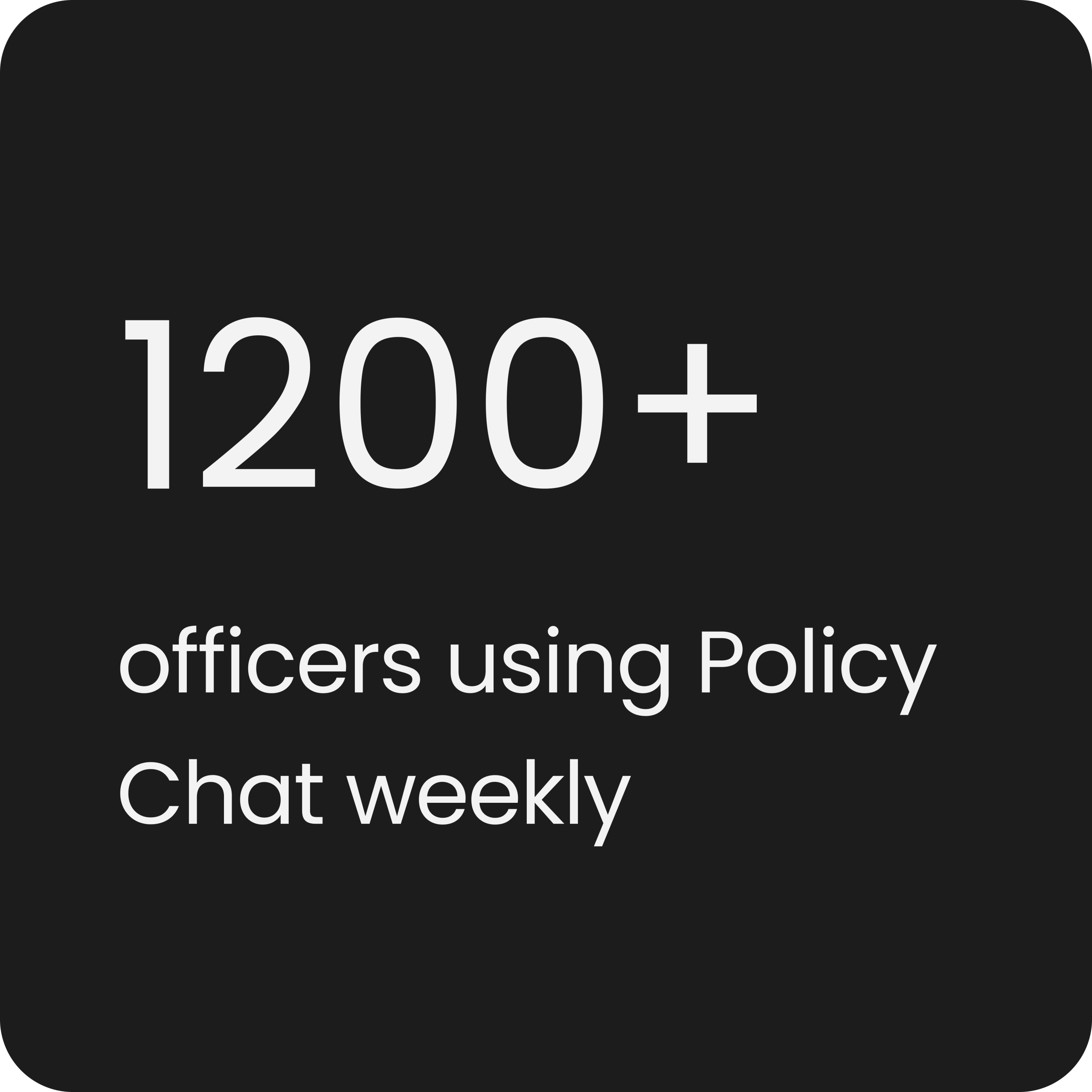
March 2024 - April 2025 launched with 1200+ users across 8 agencies
Problem: Slow answers where speed matters
📈 Blind spots in crime and gang analytics
Chiefs lacked integrated, advanced analytics across Axon products to understand crime trends, hotspots, gang activity, and the effectiveness of interventions.
🤔 Policy gray areas in the field
Patrol officers and trainees constantly needed clarification on policies like use of force, pursuits, or reporting standards, especially in the field.
📟 Supervisor bottlenecks and painful PDF hunts
The default workflow was to call a supervisor or a colleague and explain the situation or dig through dense policy PDFs on a phone or MDT, which was slow and often impractical in time - sensitive situations.
😨 Low confidence for new officers
New officers and trainees felt this pain even more because they lacked mental models and confidence around policies, rules, and standards in addition to the embarrassment of calling their supervisor multiple times.
How might AI help agencies surface both meaningful incident insights for leadership and fast, trustworthy policy guidance for officers - without bypassing the agency’s own source of truth?
The first pivot that shaped the users
The work began as “AI for incident reports,” but midway through discovery a different pattern emerged: chiefs still wanted better analytics, yet on multiple ride‑alongs I observed that trainees repeatedly calling supervisors or dug through policy PDFs to find answers. Observing this behavior in the field quietly shifted the brief from just reports to a second, sharper opportunity - policy access.
💬 Two primary personas shaped the direction:


Chief (strategic analytics)
Needs near‑real‑time insight into crime and hotspots to adjust patrols, budgets, and interventions.
Patrol officer (policy access)
Needs quick, reliable clarification on policy while responding to incidents or writing reports, especially early in their career.
IACP in October 2024: Validation & Pivot
At IACP, I put both concepts—Incident Chat and Policy Chat—in front of chiefs and officers using their real questions, from use‑of‑force to mental health calls. Policy Chat clearly won the room: officers stress‑tested answers with edge cases and repeatedly asked, “Would I rely on this in the field?”
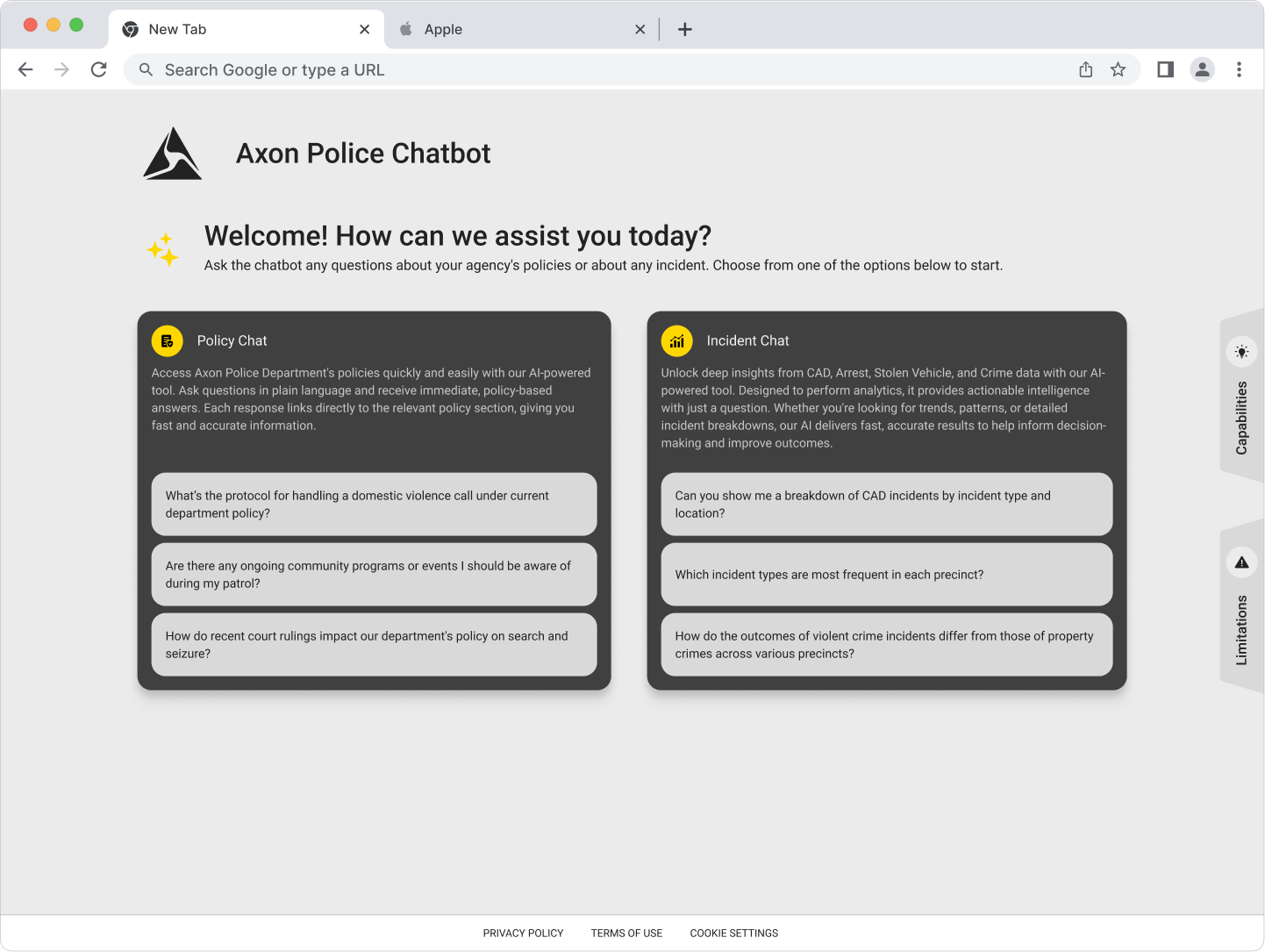
Two clear paths
The home screen separates Policy Chat and Incident Chat into distinct entry points with example questions, so officers immediately know whether they’re asking about policies or analytics instead of guessing what the AI can do.
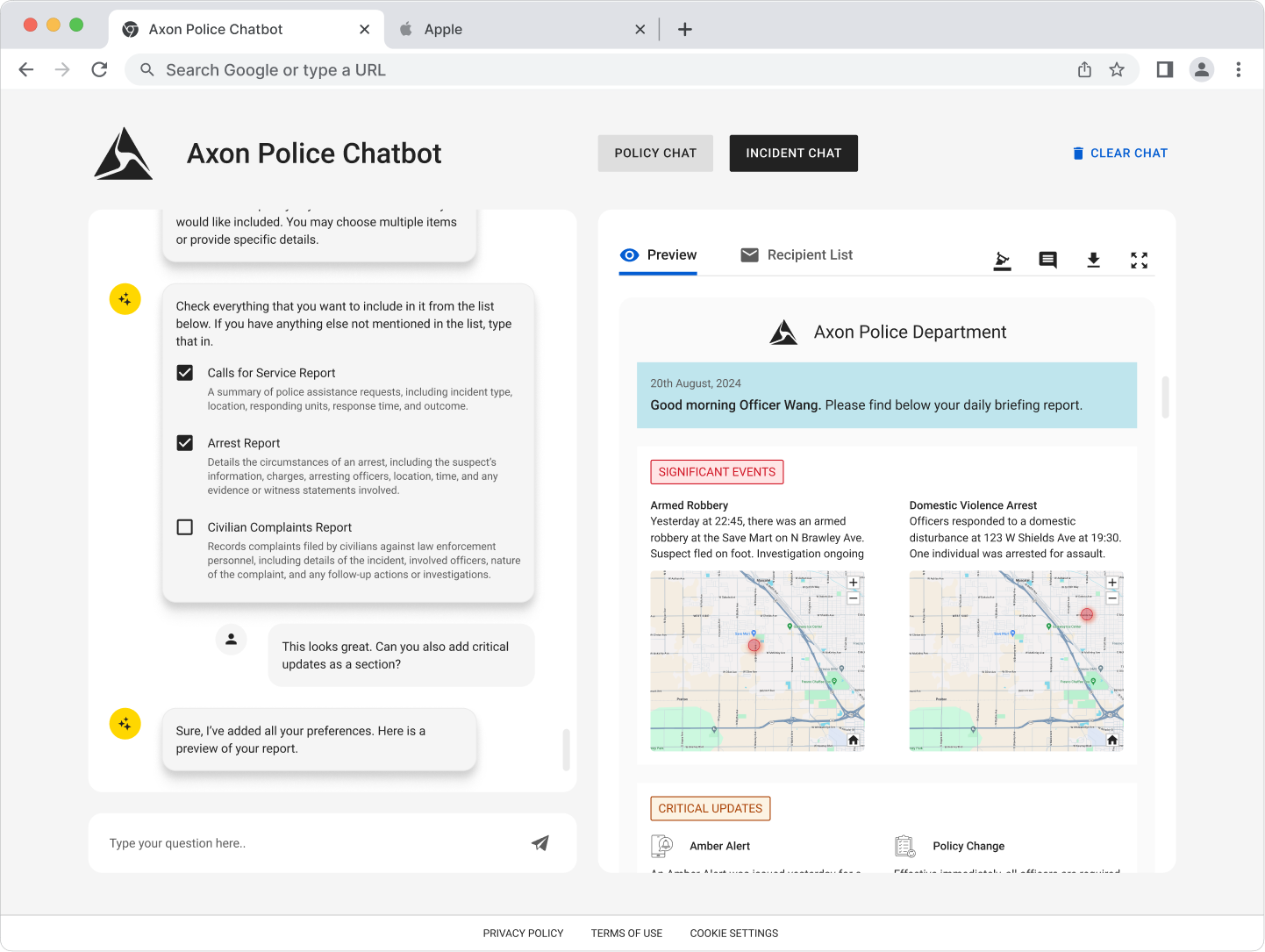
Daily briefings
Incident Chat assembles raw incident data into a clear, ready‑to‑send briefing officers can scan in seconds.
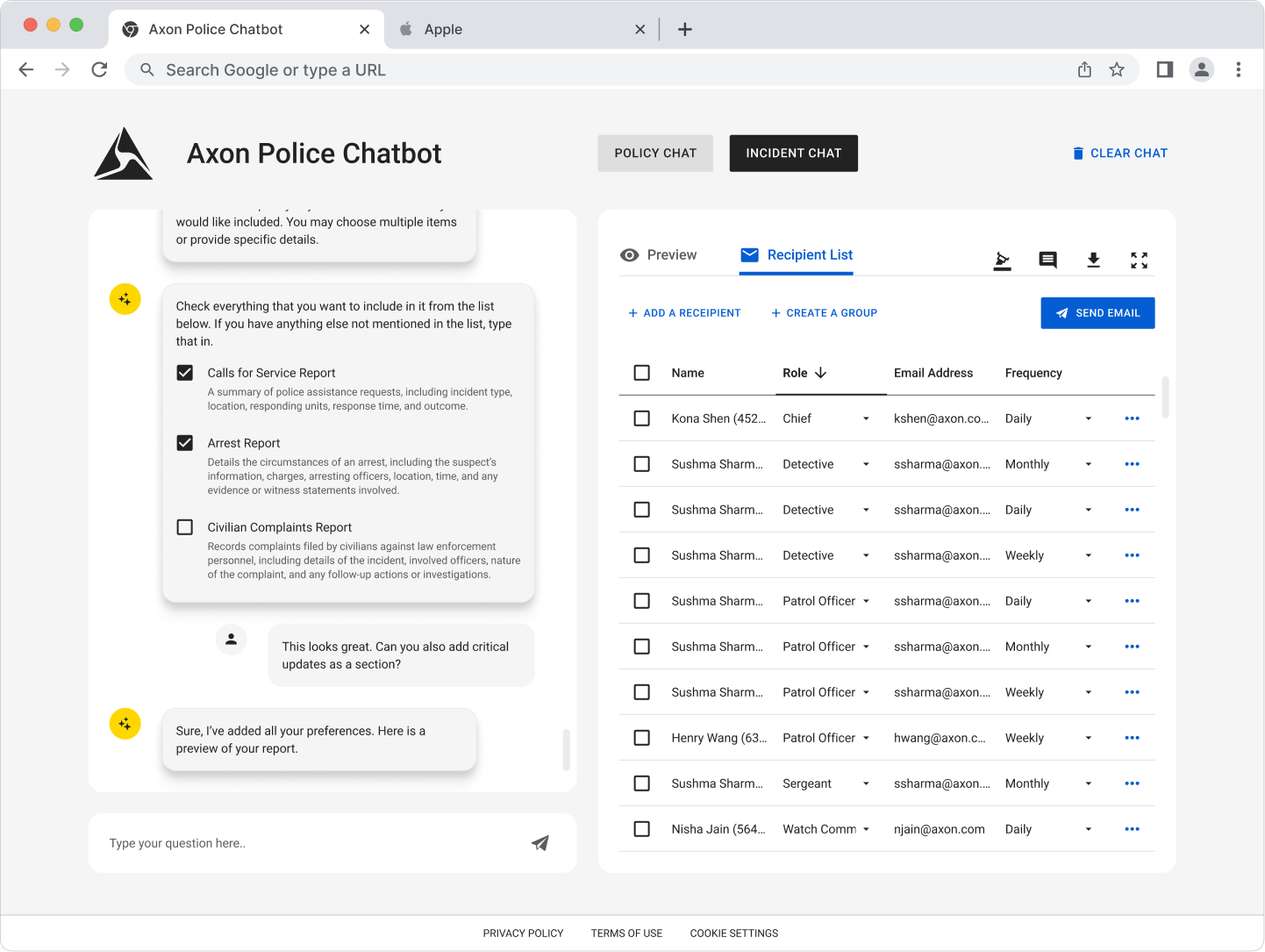
Smart routing
Admins can control who gets which briefings and how often, so chiefs, detectives, and patrol stay aligned without manual forwarding.
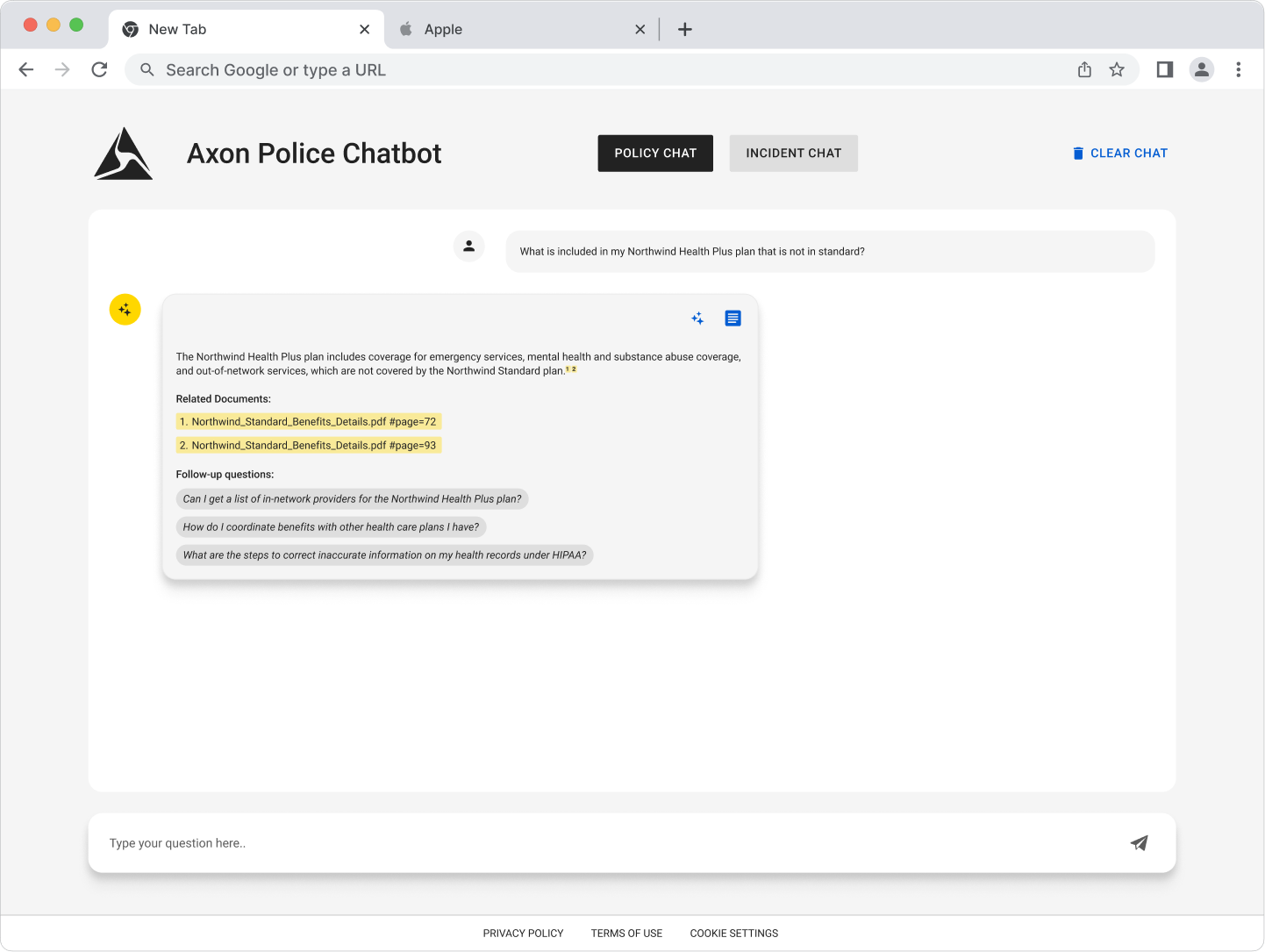
Verify in one click
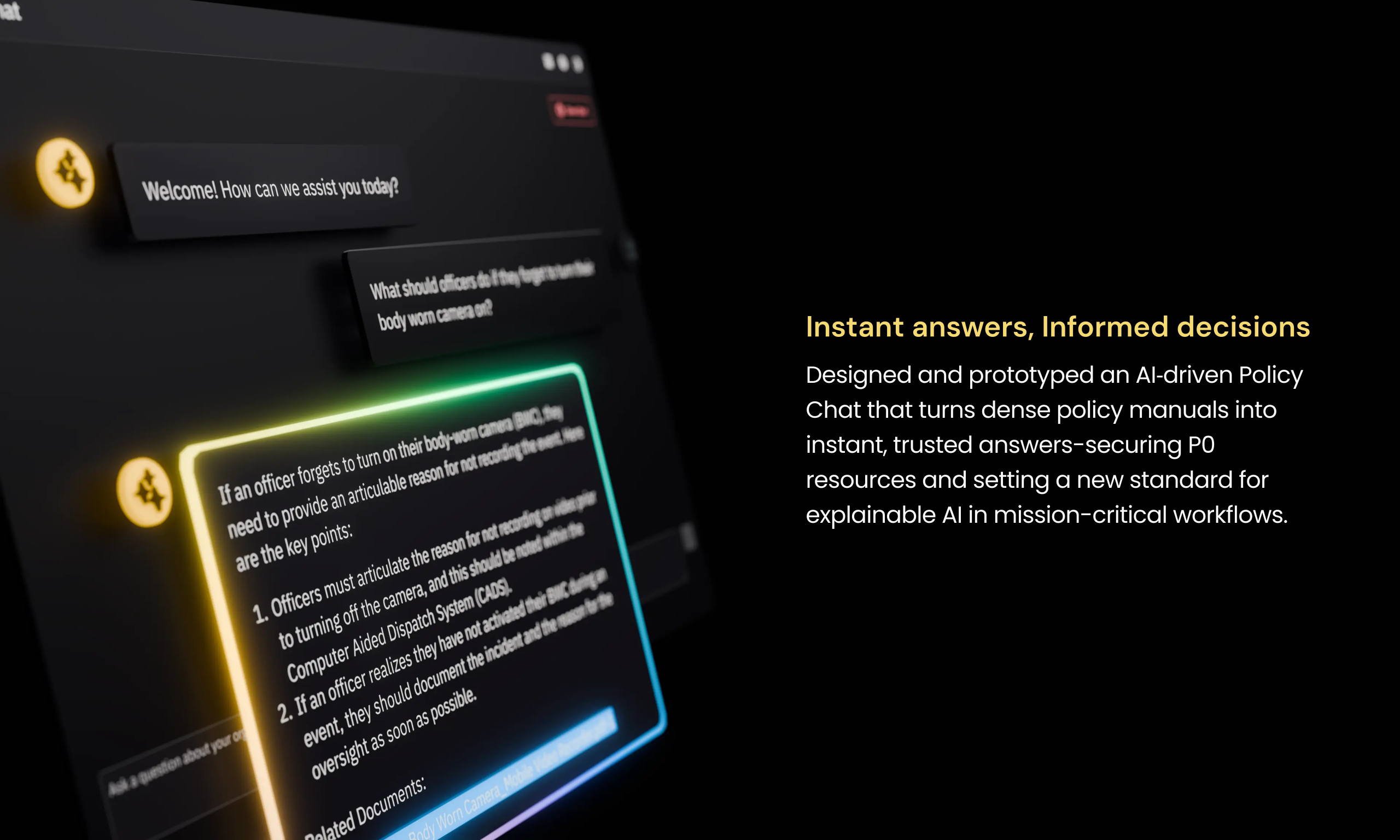
Every response includes deep links to the exact policy pages and suggested follow‑up questions, so officers can verify details instantly and explore edge cases without re‑typing their question.
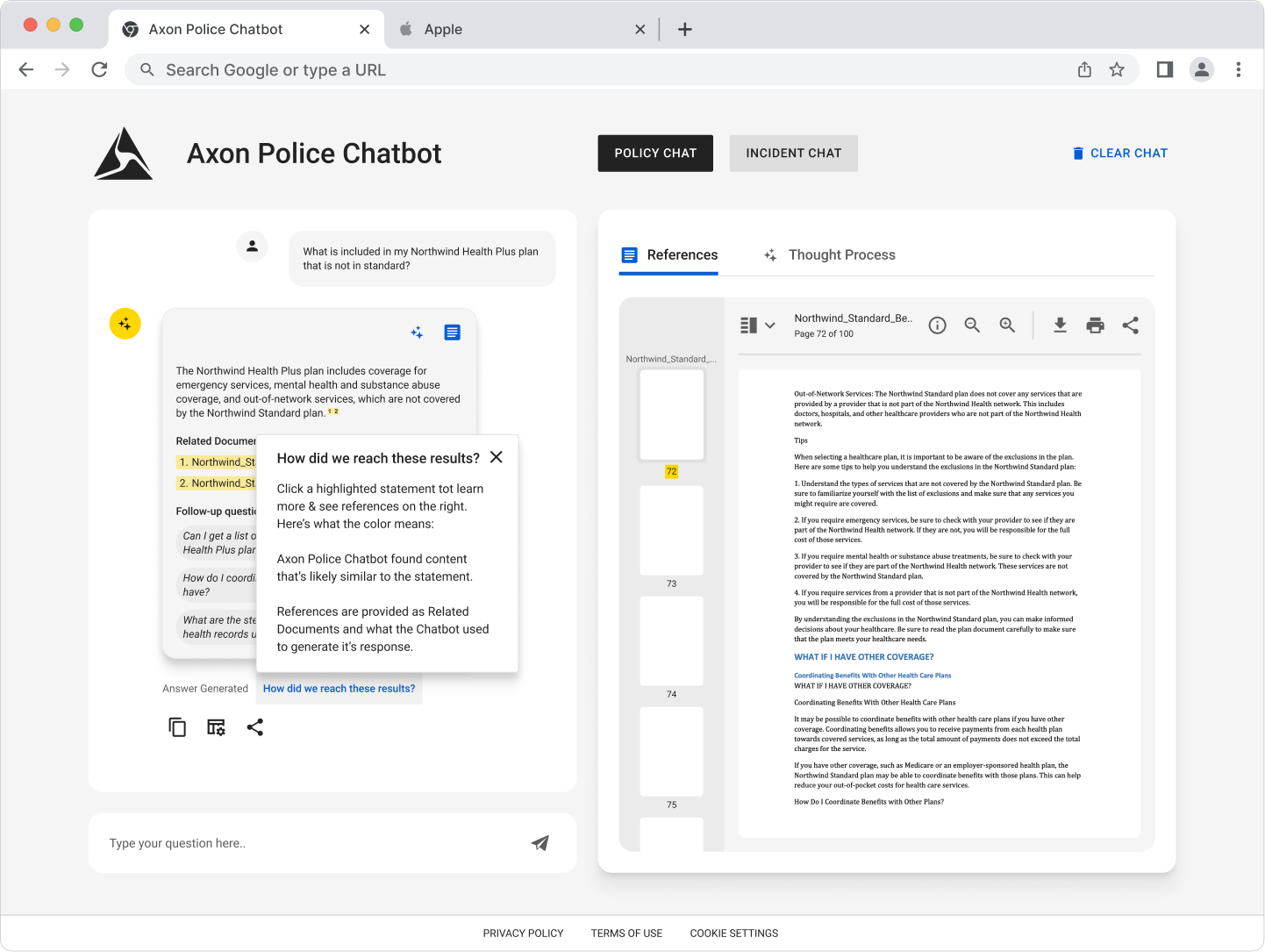
Explainable answers
Policy Chat lets officers see exactly how an answer was generated, with highlighted statements, linked references, and a plain‑language “how we reached this” explainer beside the source PDF.
“Is this enough to trust and share?”
The hardest questions weren’t about the UI; they were about how much people could rely on these answers in real training and supervision scenarios. Supervisors imagined wanting to share an answer or its source policy directly with a trainee - either to coach them or to cross‑check understanding - raising expectations that Policy Chat needed to support safe sharing, not just solo lookup. Chiefs and trainers also surfaced anxiety about policy versions and where the “real” documents live today, explaining that many agencies store policies in third‑party systems like PowerDMS and would need integrations to keep Policy Chat aligned with the latest official version.
Reframed design choices and future bets
🧷 Citations as a safety feature, not a flourish
Citations and deep links into the original PDF weren’t “nice touches”; they were critical to let people trust and cross‑check answers in supervision and training.
ℹ️ From solo lookup to shared coaching
Sharing and collaboration patterns (e.g., sending an answer or policy snippet to a trainee) became an important future direction instead of an afterthought.
✅ Staying in sync with the real source of truth
Integrations with third‑party policy systems like PowerDMS moved onto the long‑term roadmap so Policy Chat could stay in sync with the true source of truth rather than relying only on manual uploads.
🌌 Scaling beyond manual uploads and pilots
Manual uploads remained the P0 path, but IACP feedback made it clear that robust versioning, syncing, and sharing would be essential for Policy Chat to scale beyond a single‑agency pilot.
Tradeoffs we made...
1. Fragmented CAD and RMS data; each vendor required custom integrations.
2. Multiple CAD connections for each software within Axon
3. High technical risk for an initial AI bet.
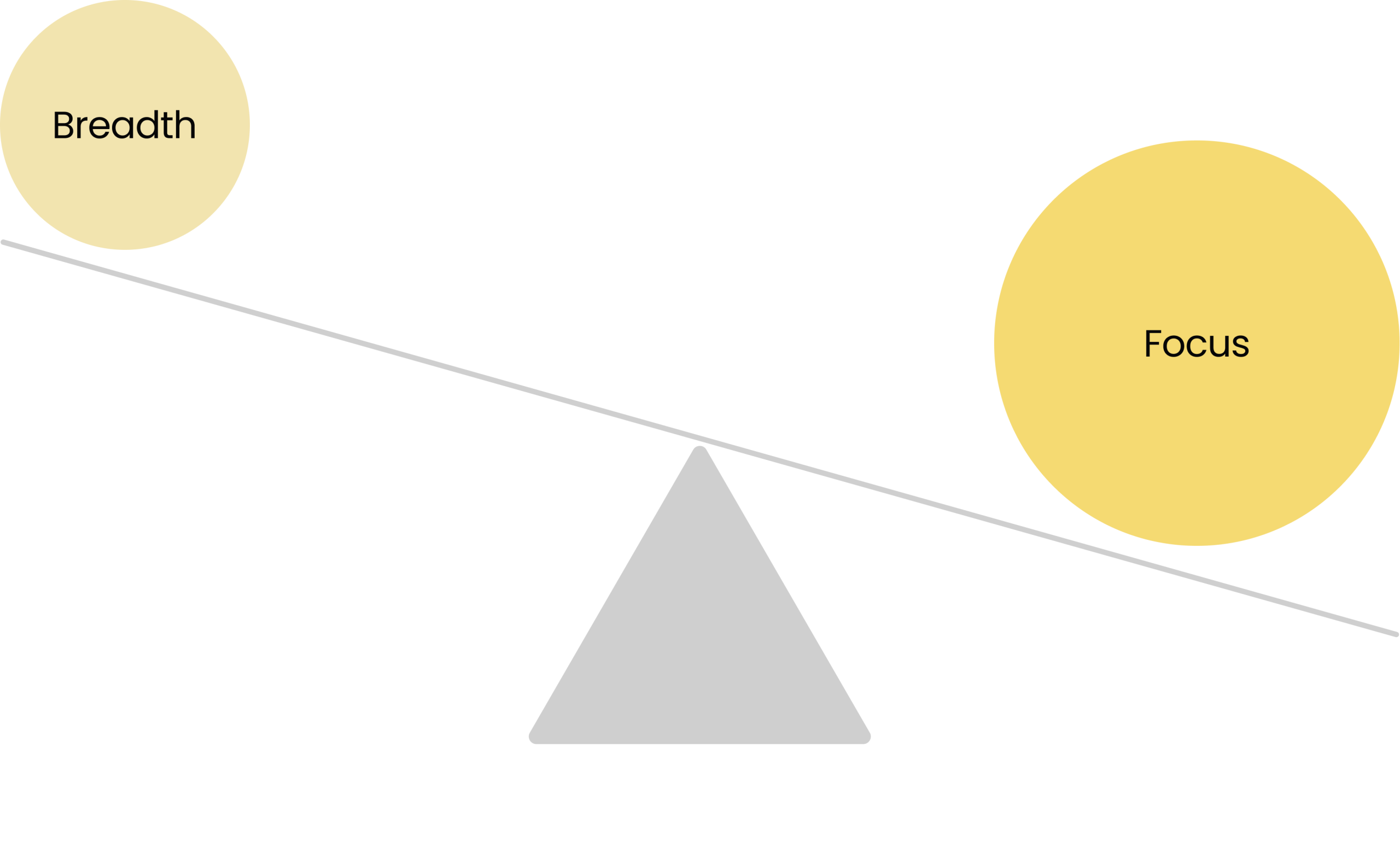
1. Smaller, more controlled data surface made safety and behavior easier to reason about.
2. Immediate value story across roles: fewer supervisor calls, faster decisions, less risk.
3. Could run on existing policy documents as a clear source of truth.
Instead of a generic policy search that drops officers into long PDFs, asks them to trust the AI, and handles each question in isolation...
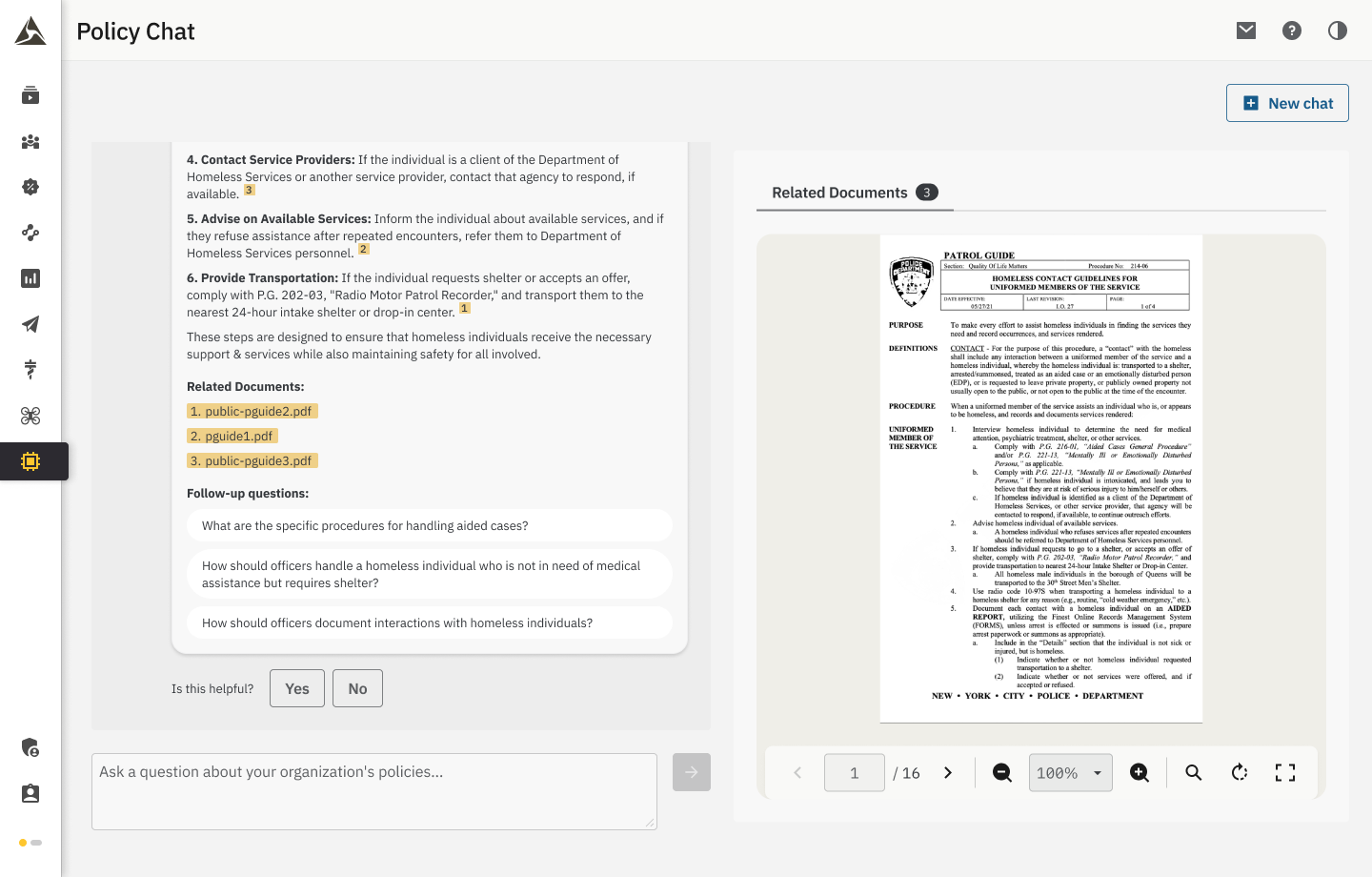
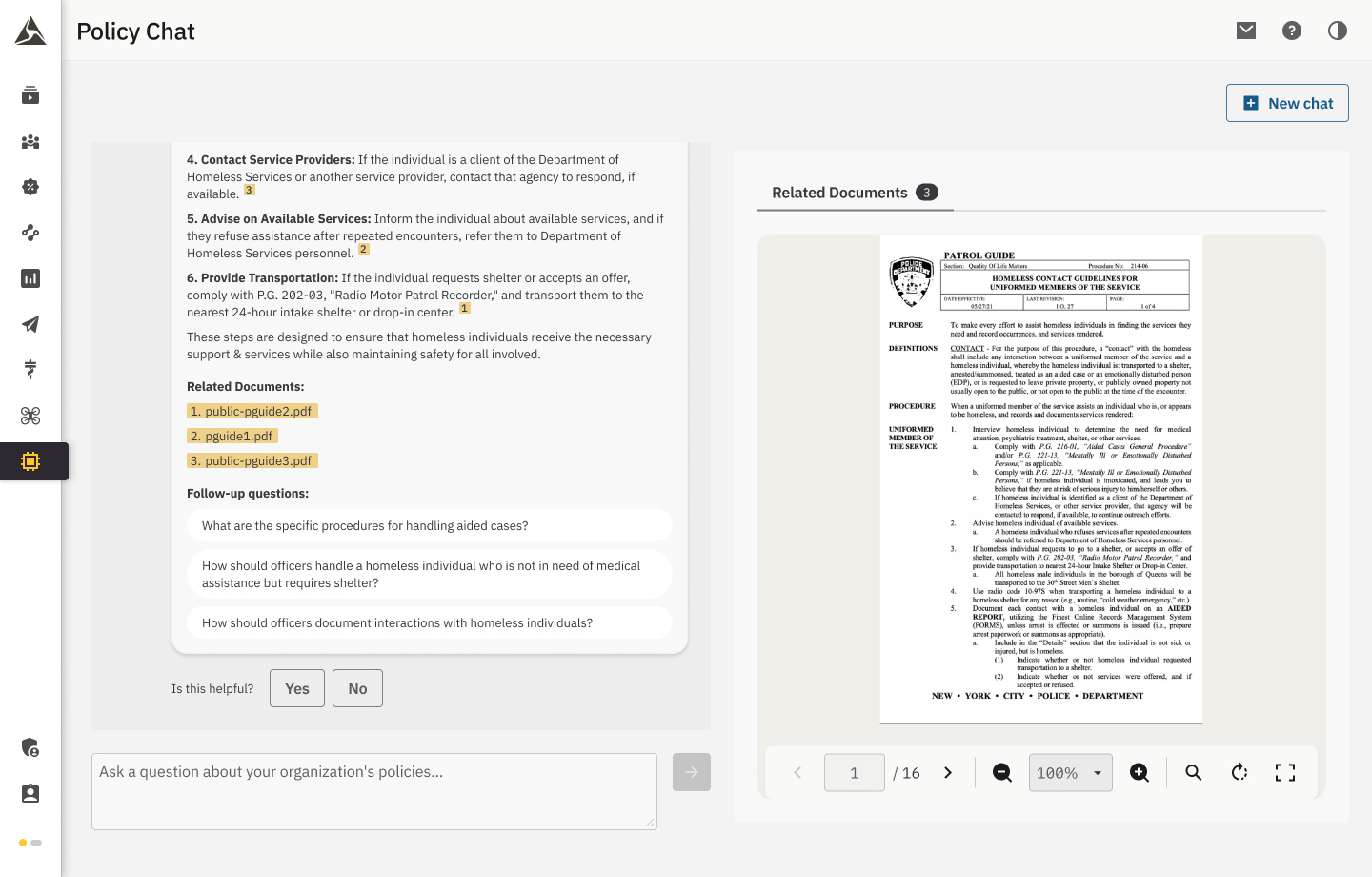
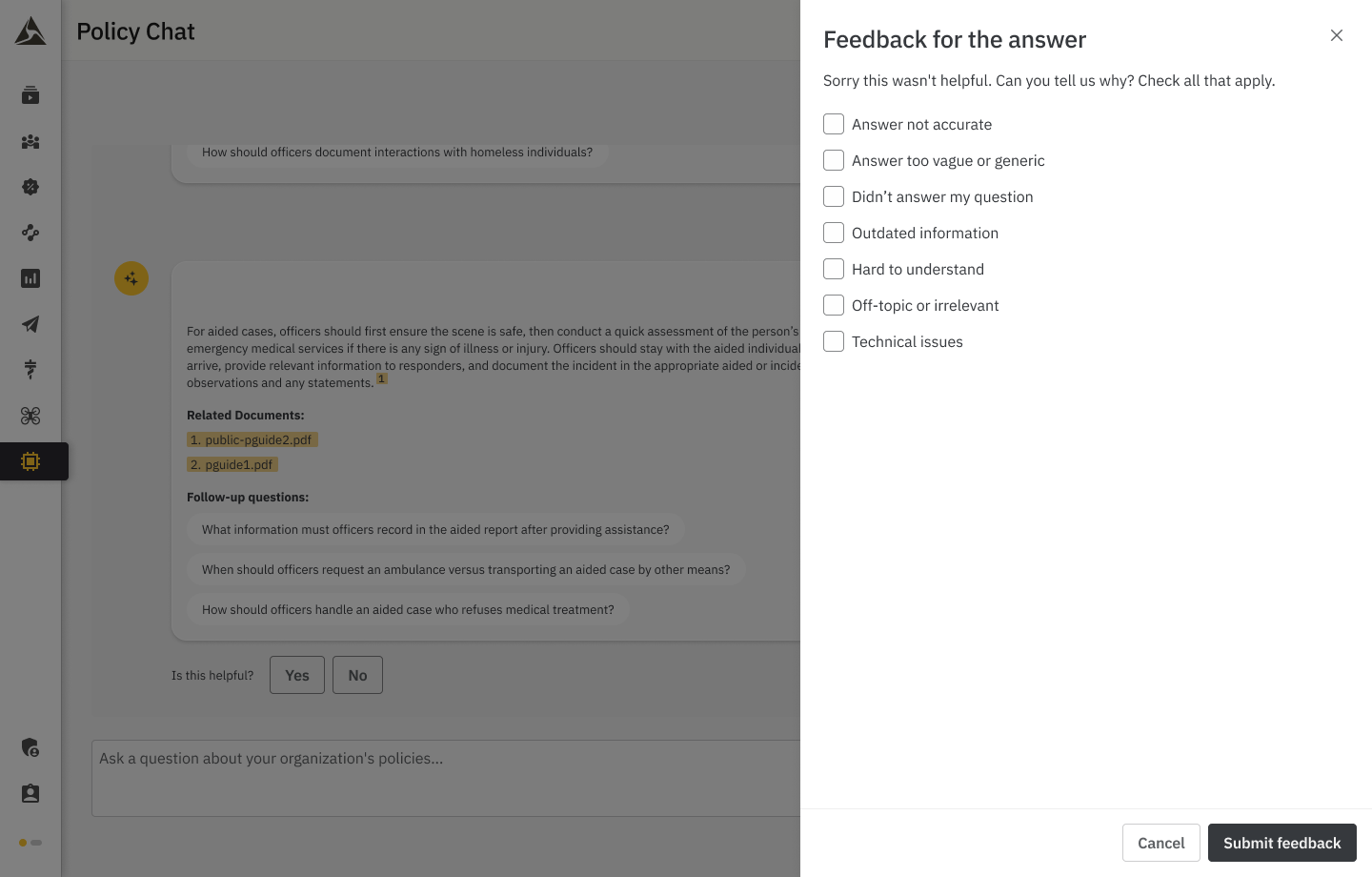
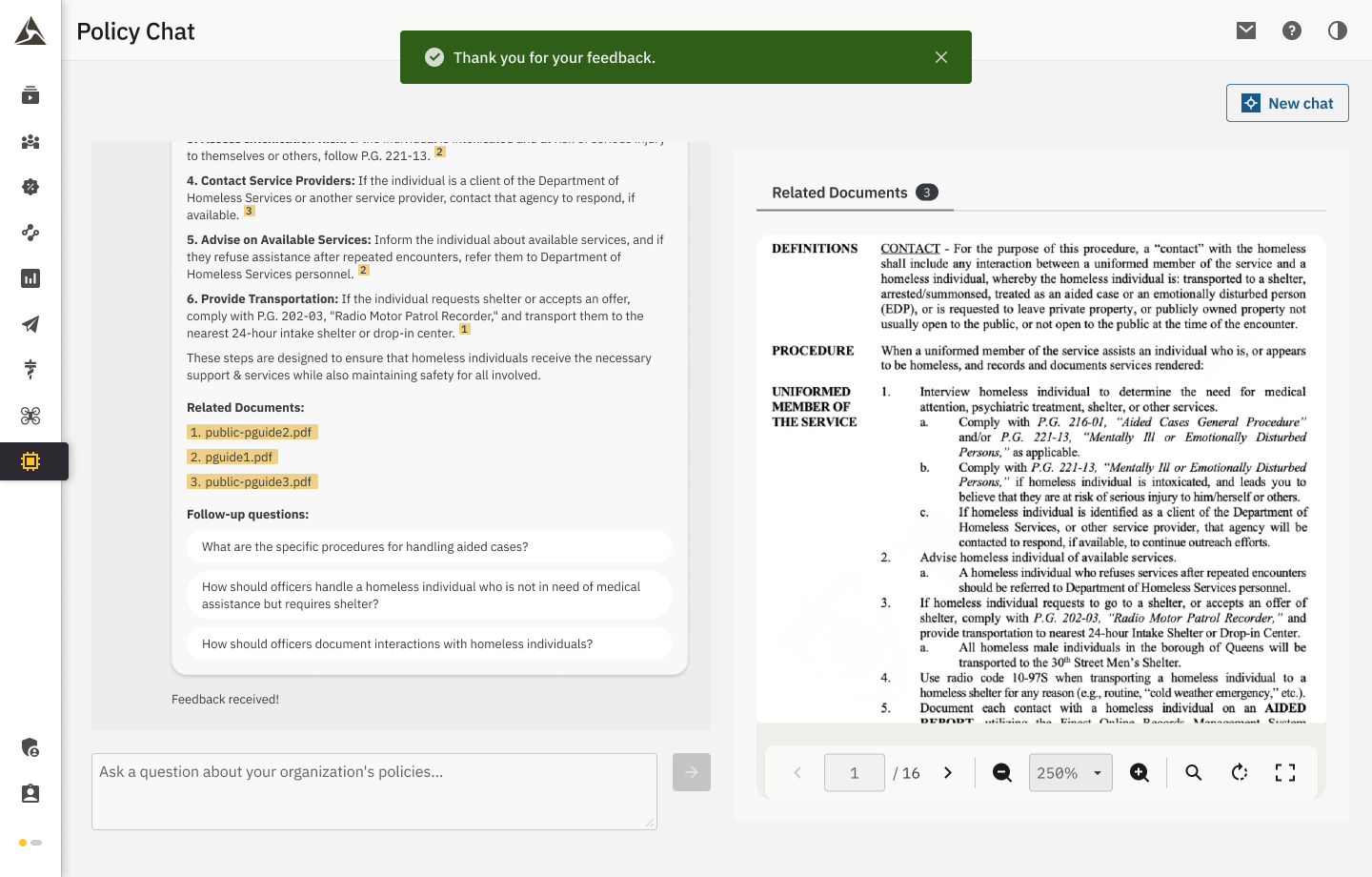
....I designed guided, verifiable answers
A single conversational flow that gives one clear, cited answer in plain language, deep links straight to the exact policy page, and guided follow‑up questions that anticipate the next thing officers will need—so they can move from question to verified decision without sifting, guessing, or re‑typing.
Instead of letting long, wandering chats quietly drift off-topic and dilute answer quality....
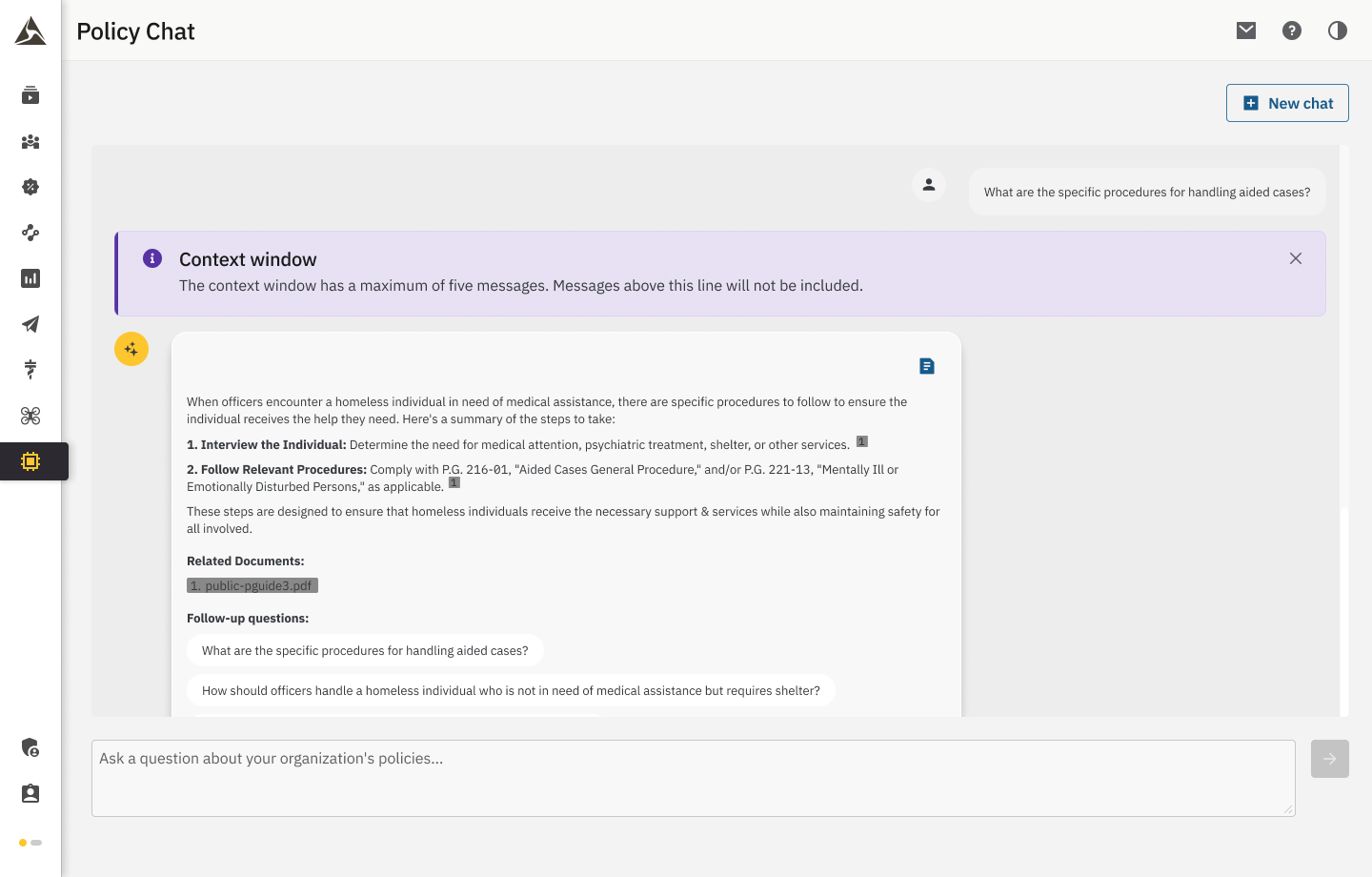
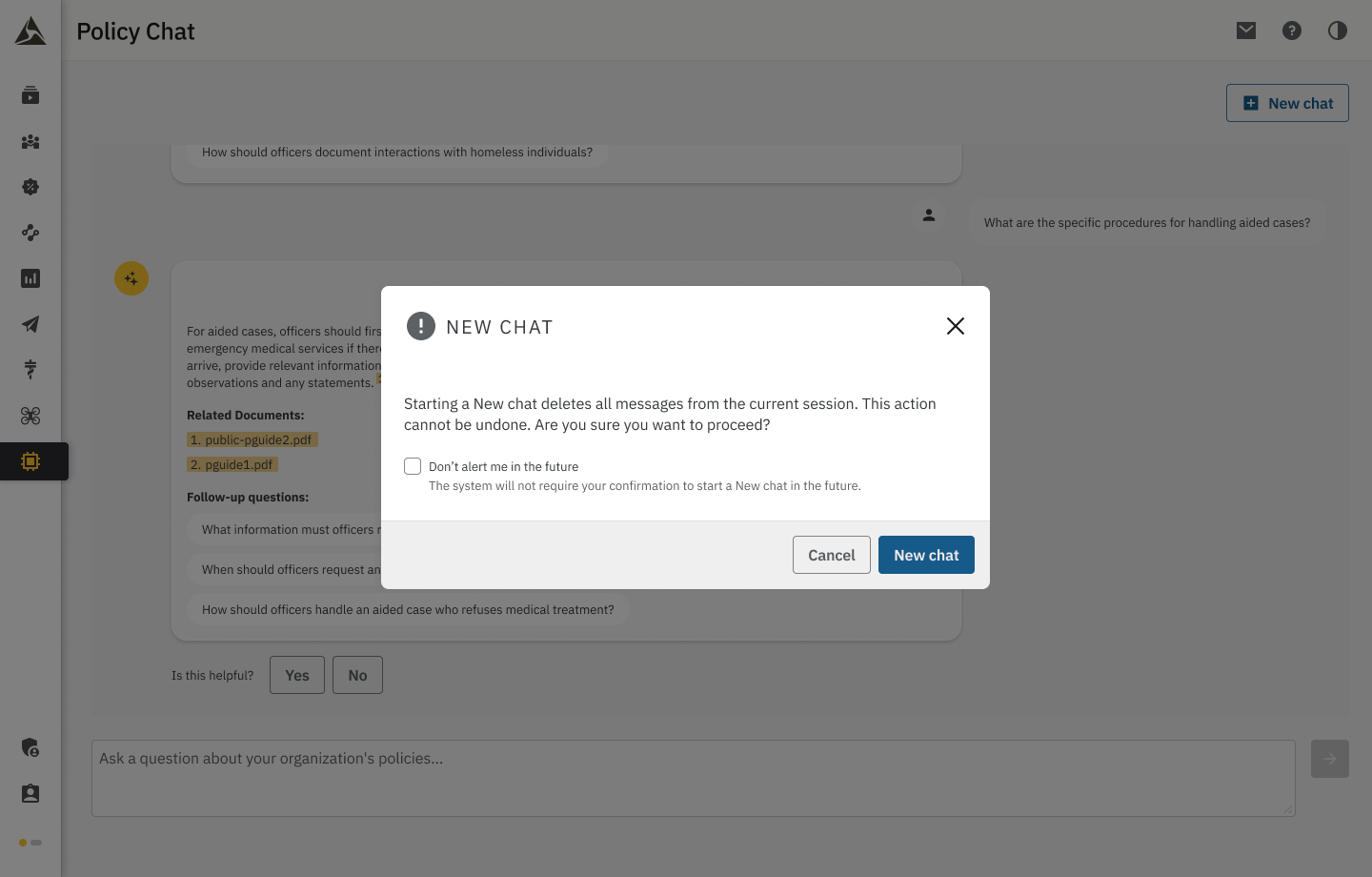
....I designed focused threads
A “new chat” pattern and clear microcopy that nudge officers to restart when they change subjects, keeping each conversation tightly scoped and more reliable.
Instead of letting an opaque AI answer from hidden sources...
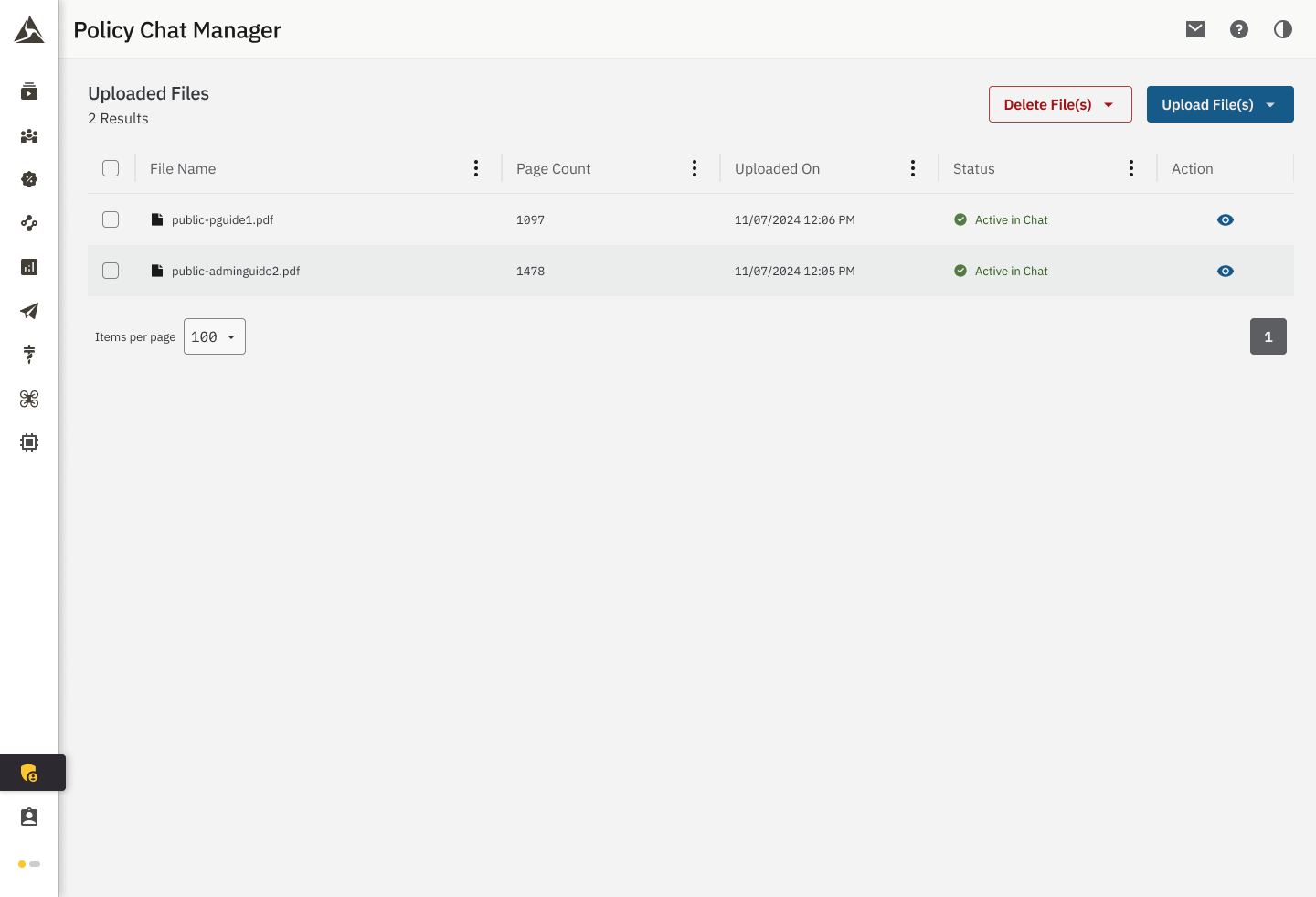
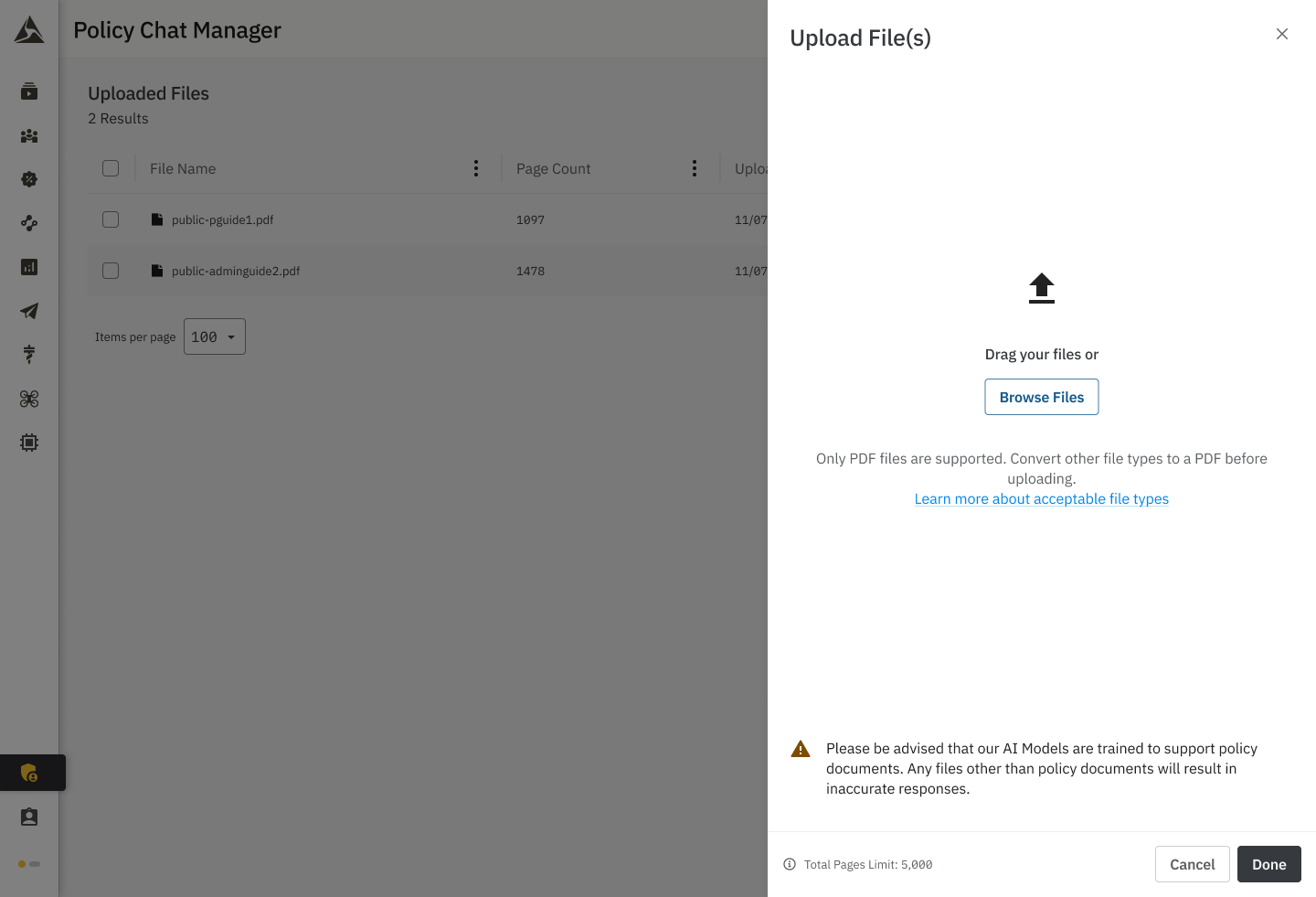
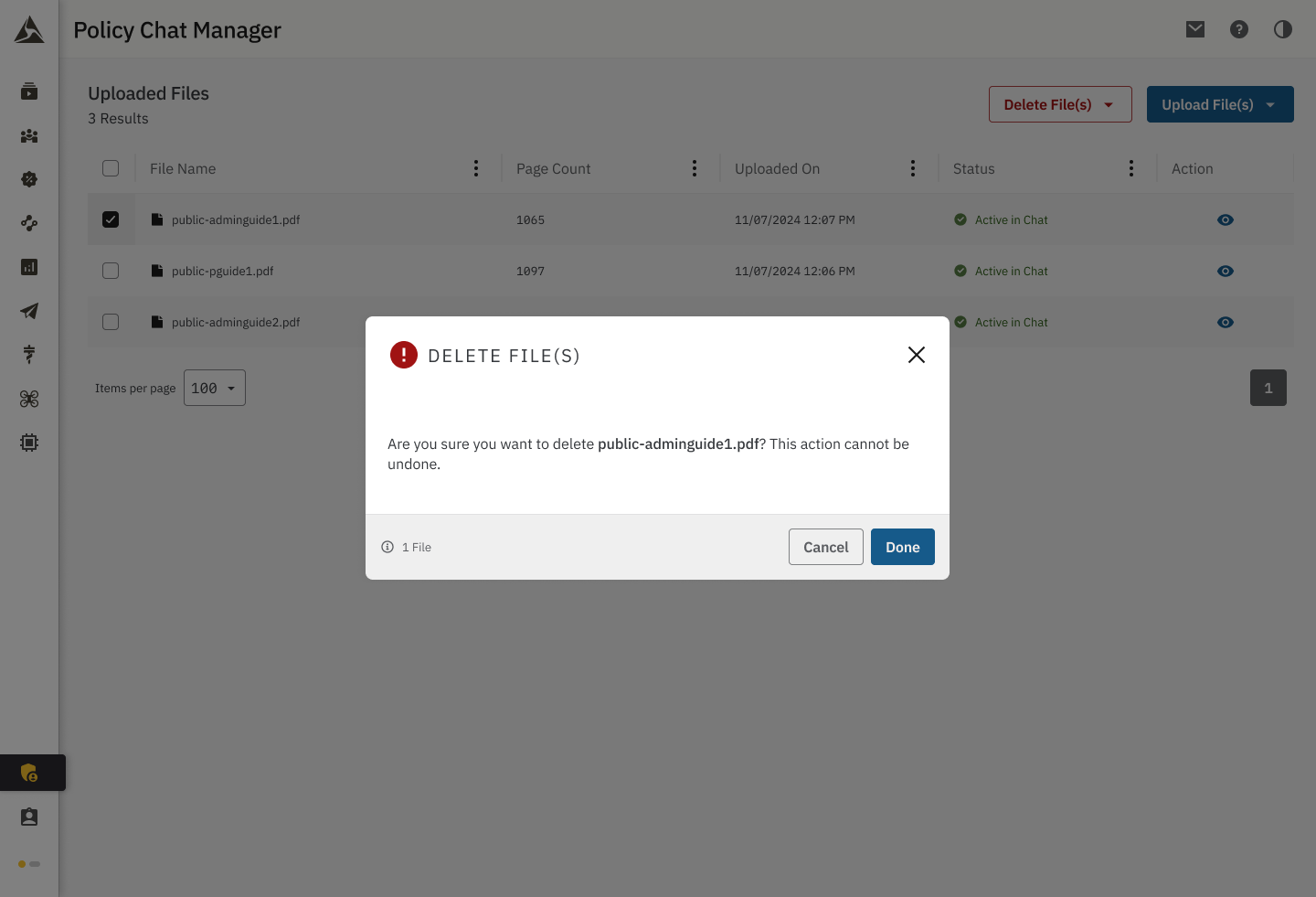
....I designed admin‑owned source of truth
A simple, web‑only P0 admin flow where agency staff upload and remove policy PDFs themselves, keeping Policy Chat grounded in their latest policies today and setting the stage for richer replace/version controls as lifecycles grow more complex.
Instead of waiting until you’re back at a desktop or MDT to dig through PDFs for policy answers...
....I designed pocket‑ready policy guidance
A mobile Policy Chat experience that keeps the same clear, cited answers and guided follow‑ups, optimized for one‑handed use and quick verification when officers are away from their desk.
What happened when Policy Chat hit the market?
✨ “When I first started, we had two telephone-sized binders of policies and were told not to bother our supervisors until we looked up the policies first - this is amazing" - Captain Schoolmeesters, Tampa PD
✨ "The onboarding was so simple. The drag and a drop makes it effortless. I added the Manual of regulations (MOR) today by myself and it was up and ready in 20 mins! - Nate Perez (IT Manager)
✨ “Trainees would finally have a supervisor in their pocket" - Chief at Axon Week 2025
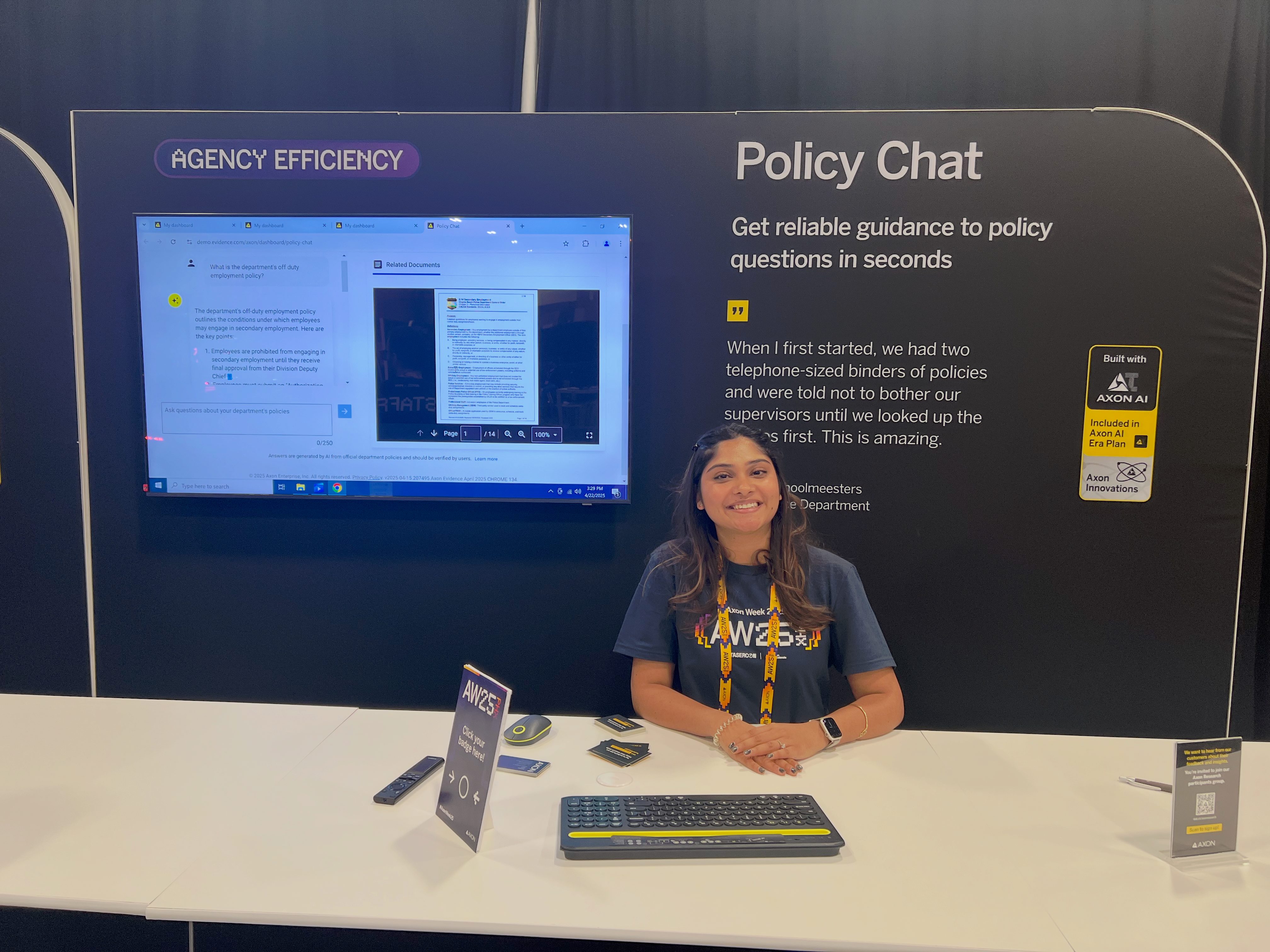
Me at Axon Week conference 2025 - presenting Policy Chat to attendees and getting feedback before launch
Reflections
This project started as an AI analytics and reporting experiment and evolved into a focused policy assistant because research and real‑world testing demanded it. It reinforced that meaningful AI work is as much about constraints, safety, and trust as it is about models.
🔄 From vague “AI idea” to a shippable P0
Took an open‑ended “AI for incident reports” brief and turned it into two concrete concepts, then a focused Policy Chat P0 with clear users, workflows, and constraints.
👮 Putting officers’ reality at the center
Balanced chiefs’ need for analytics with the sharper, in‑the‑field pain officers and trainees faced getting policy answers - letting real behavior (supervisor calls, PDF hunts) reshape the product direction.
😵 Designing AI under real constraints
Worked within fragmented CAD/RMS data, limited context windows, no persistent history, and manual policy uploads - using patterns like “New chat,” admin‑managed docs, and lightweight feedback to keep the product reliable and shippable.
🚧 Creating a principled roadmap, not a demo
Helped shift “AI at Axon” from generic assistant to a focused tool that lives in an officer’s workflow, with future work (document versions, history, deeper analytics) all anchored in the same principle: fast answers, grounded in the agency’s source of truth.
Powered by  & made with
  | Designed by Nisha Jain © 2026